[vc_row][vc_column][vc_column_text css_animation=”fadeInRight” css=”.vc_custom_1449050239692{background-color: #c2e3ed !important;}”]Except you’re totally new to the industry, or you’ve been living under a rock in the faraway lands of another planet, you’ll have heard about responsive design. Even if you don’t understand it fully, it’s bound to be something you’ll have come across or interacted with in some way or another.
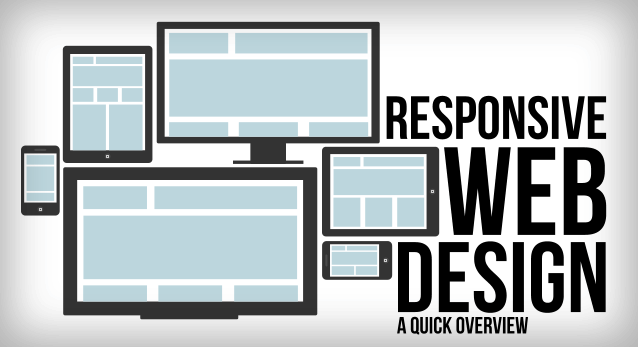
In short, responsive web design is the art of designing webpages for a mass of screen sizes and devices, so that there is an excellent experience for every user at every possible dimension.
Responsive web design is at its best when it’s device skeptic; where you’re not aiming to design for particular resolutions or sizes, such as for iPhone or iPad sizes only. Rather you should be aiming to design with the content and design in mind and how this content flows and to the various environments it might be seen or used in.
Designing for a Responsive Web
It used to be the case that to access the internet you’d have to try through a (usually very large) computer, with the familiar sounds of the modem sounding while you connected. Now though, you can access the internet through computers, laptops, mobile phones, smartphones, tablets, televisions, games consoles – the list feels almost endless.
Now, on one hand this is great news. More than ever before, we can be connected to the internet at any time or place that we might want to. Whilst this is taken for granted, for many it’s also necessary. And with necessity and access we’re also often presented with impatience and the need for things to work, and work quickly.
Due to responsive websites becoming much more mainstream, even the general public (so everybody outside of the web and creative industries) have almost come to expect it when they’re browsing the web. So, all in all, responsive web design is definitely a big thing.
The Challenges a Responsive Web Delivers.
Working with responsive design isn’t without its challenges. First of all, there are such a numerous of devices and screen sizes that we have to provide for. From large to extra-large screens, from small to mid (and everything in between) there’s a lot to think about. And, as I’m sure you already know being a developer, working with responsive design from the technical side of things can also turn nightmare-ish and be extremely difficult to handle.
Like with any project, the main things you need to think about with responsive web design are the content of the website, how this content fits into the design and how the content flows from page to page. You need to look at how the different design elements you have work together and ensure that everything feels cohesive and consistent.
The difference with responsive web design is that you also need to think about how all of this works from one size to another, whether that is width or height based. You need to think carefully about how all of this translates to a smaller or larger screen and how all of your design elements, your content flow and everything else works. You need to keep the experience consistent, no matter the size of the website.
Working with Clients and Managing Expectations
We, as designers and developers in such a fast-paced industry, are pretty lucky. We get to work on some amazing projects and we’re usually always getting to work at the forefront of new and emerging technologies. Working with responsive web design is just one of those exciting things we get to do, but with that, comes a price.
Think back to the article about trends and think of the conclusion you may have drawn yourself about whether they’re good or bad. Think also about buzzwords; those words that you see flashed around on business or news websites about these new, exciting, emerging technologies. Now, some of the clients you get may be a little educated about the web and understand it. They may even work in the web themselves and need a little extra help. Some of your clients, however, may not be as well educated about the web and may see those buzzwords as an essential, no matter what. I’m going to briefly talk about those kind of clients in this section.
Establishing What a Client Wants
At the beginning of any design project you should be trying to establish exactly what it is that your client wants to get out of the project and what they expect the outcomes to be. Managing your client’s expectations can be a difficult thing to do, but it’s important that you keep at it to ensure that your clients understand your process fully.
When it comes to responsive web design, and particularly if they’ve come to you with one of these buzzwords, you need to try and help to educate your clients. Quite often, these buzzwords have been heard in passing, or have been represented wrongly, and it’s up to you to make sure that your client has a proper understanding of the subject.
For example, sometimes you might even get potential clients coming to you saying that they wanted a website that worked on “iPhone and iPad”. In this instance, I would say “Well, that’s perfectly fine – but what would be great is that we can instead focus on creating you a perfectly responsive website that will work on any device and not just be restricted to those two.” That’s a great ice-breaker on the subject and it’s something that leaves it very open for you to explain further into the planning stages.
If your client understands responsive design properly, then I imagine they will be happier with the project.
Hope you find this article quite clear. We feel great to provide you such kind of information, which could be great step for your thriving web design company in Nepal. –Websoft Nepal[/vc_column_text][/vc_column][/vc_row]